
We wrote this for software companies, SaaS products, marketplaces, booking and ordering platforms, and agencies that look after client sites. In these businesses the PHP code is the product, or close to it. When it breaks, customers notice before the team does, and nobody can say "we will look at it next month".
The requests we get for PHP developers fall into a few patterns. A live Laravel site throws an error and payments have stopped. A platform needs a supplier feed, a payment gateway or a mobile app connected to it. An old Joomla or CodeIgniter site has to move to something current. Or a company wants a PHP developer for six months or longer and does not want to hire one in-house. We take on all four, and the way we start is the same each time.
What does a PHP developer do for a software or platform business?
Keeps the platform running, fixes what breaks, and builds what the business needs next. PHP still runs a large share of the web, through WordPress, Laravel, Magento and many custom systems, so the work is rarely a blank page. It is usually an existing codebase with users on it.
- Laravel web apps, portals and dashboards: user roles, admin panels, reports, booking and ordering flows.
- WordPress and WooCommerce work that goes past the page builder: custom plugins, custom post types, checkout changes and performance fixes.
- APIs and integrations: payment gateways, supplier and inventory feeds, CRM sync, and the backend a mobile app calls.
- Upgrades: moving to a supported PHP version, stepping a framework up release by release, or replacing a CMS that no longer gets updates.
- Data migration: moving records out of an old system or flat files into MySQL, with checks that nothing went missing.
- Bug fixing and speed: reading error logs, slow database queries, scheduled jobs that fail without telling anyone.
- Day-to-day support: small changes, content fixes and monthly updates, so the platform does not drift out of date.
Which PHP frameworks do we work in, and why Laravel?
Laravel and WordPress most of all. Both appear across our portfolio, and Laravel is what we choose for most custom builds: it has a published support policy, so you know how long each version gets security fixes, and our Laravel developers can step it up one release at a time. We also take over older frameworks and plain PHP, and the first review tells you whether we recommend keeping, upgrading or replacing what you have.
| Platform | What we usually do on it |
|---|---|
| Laravel | New portals and web apps, feature work on existing apps, version upgrades, API development, queue and scheduled job fixes. |
| WordPress and WooCommerce | Custom plugins and themes, WooCommerce checkout and product logic, supplier feed imports, speed and security clean-ups. |
| Magento | Store support, extension conflicts, catalogue and inventory sync with ERP or warehouse systems. |
| CodeIgniter, Yii and plain PHP | Keep it running safely, fix what is broken, and plan a move to Laravel only when the cost of staying is higher. |
| Joomla and older CMS sites | Upgrade where a supported path exists, or rebuild on WordPress or Laravel and keep the URLs that bring in traffic. |
| PHP-based CRMs and admin systems | Custom modules, fields and integrations, read and tested like any other PHP codebase before anything is changed. |
Can you fix a PHP error on a live site today?
Often, yes, once we have access. The urgent requests follow a pattern: a Laravel or WordPress site shows a blank page or a 500 error, a checkout has stopped taking payments, or a function is failing on every request. The owner wants it fixed now, or at least switched off safely.
We start with the error log, not guesses. Before touching code we take a backup of the files and the database. If the fault is in one function that can be safely disabled, we disable it first so the site works again, then find the cause. Most live errors trace back to something that changed: a hosting provider moved the server to a newer PHP version, a plugin or package updated itself, or someone edited a file directly on the server. Once the site is stable, we tell you what caused it and what stops it happening again.
To move fast we need hosting or cPanel access, the code (a Git repository, or FTP if that is all there is), an admin login, and a sentence on what changed just before it broke.
What happens when we take over a PHP project someone else built?
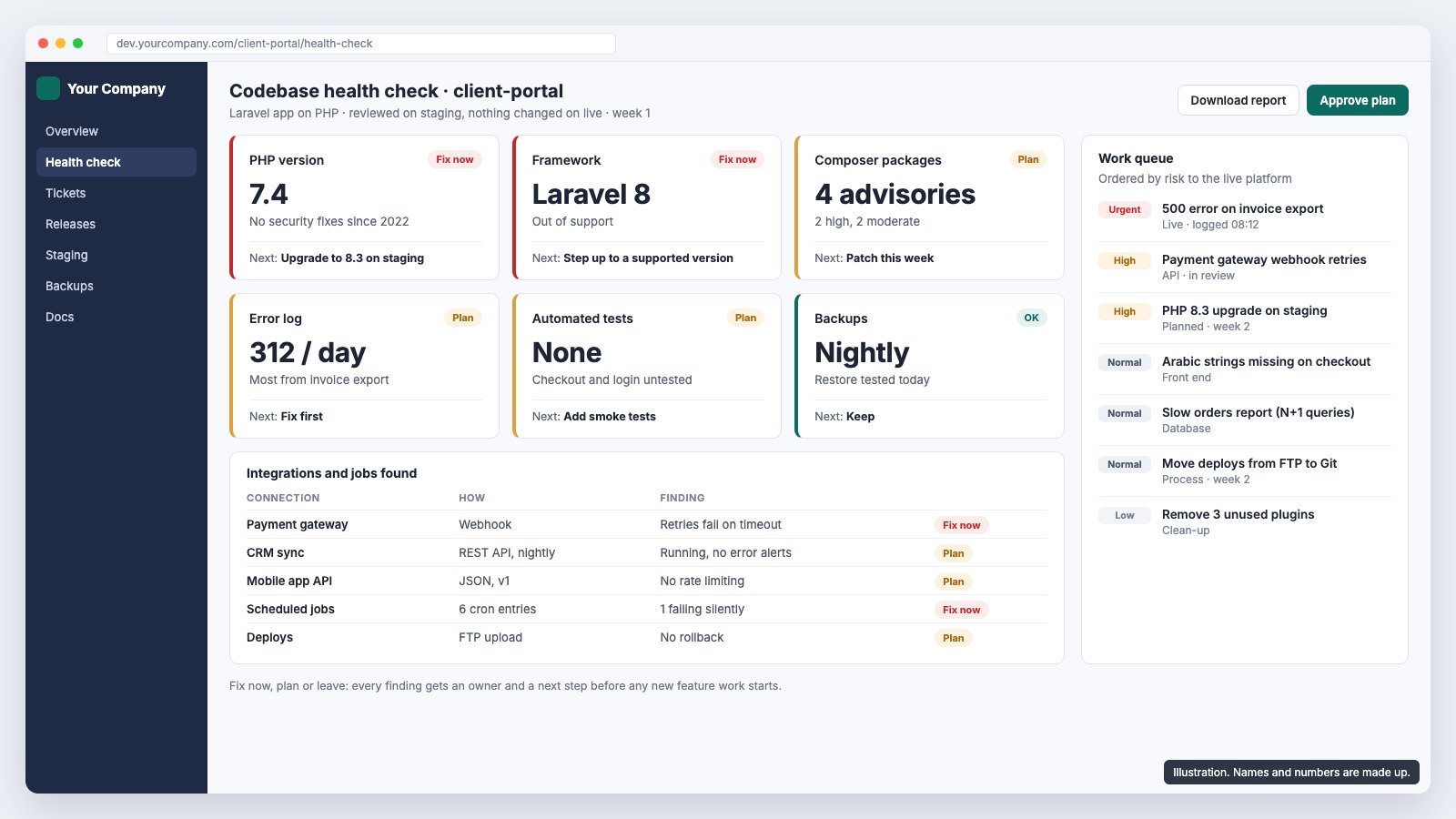
A health check before any new feature work. Taking over someone else's PHP code without reading it first is how one fix turns into three new bugs. The cover image above shows the kind of report that comes out of that week.
- 01Access and backups. We confirm backups exist and that one can actually be restored, before we change anything.
- 02A copy on staging. We run the platform away from your customers, so testing never touches live orders or user data.
- 03Versions and packages. Which PHP version, which framework version, and which installed packages have known security issues.
- 04Logs, jobs and slow pages. What errors repeat, which scheduled jobs fail quietly, and which database queries slow the busiest pages.
- 05Integrations. Every payment gateway, API, webhook and sync the platform depends on, and what happens when one of them is down.
- 06How code reaches live. Whether there is version control and a way to roll back, or whether changes are uploaded by FTP.
- 07A written plan. Each finding is marked fix now, plan or leave, with a next step, and you approve the order of work.
The plan is yours to keep. If you decide to do the work in-house or with someone else, it still tells them where the risks are.
When is a PHP 8 or Laravel upgrade worth doing?
When your PHP or framework version no longer gets security fixes, and that covers more platforms than owners expect. PHP 7.4 stopped receiving security fixes in November 2022, and PHP 8.0 and 8.1 are out of support too. Laravel gives each major version about two years of security fixes. Hosting providers then retire old PHP versions, and a site that was fine on Friday breaks on Monday after a server change.
Upgrades break things in predictable places: functions removed in PHP 8, stricter handling of null values, older packages that will not install on the new version, and custom code that relied on loose behaviour. We do the upgrade on staging, update the packages, run the critical journeys (sign-up, login, payment, checkout, the admin reports your team uses daily) and only then switch live, with a rollback ready. On an older framework we usually step up one version at a time rather than jump, because each step is smaller and easier to test.
Sometimes the honest answer is that an upgrade costs more than a rebuild. If the site is an old CMS with no supported path forward, we say so and quote both. Our guide to redesigning a website without losing Google rankings covers how we protect traffic when the platform changes underneath.
Can a PHP developer integrate payment gateways, APIs and your CRM?
Yes, and for platform businesses this is often most of the work. A good share of the PHP requests we see are integrations: a supplier's product API feeding a WooCommerce store, a payment gateway with webhooks that must not miss an order, a CRM that needs every new customer, or a mobile app that needs a clean API behind it.
- Payment gateways used in the UAE, plus instalment providers such as Tabby and Tamara on stores, with webhooks that retry and log failures.
- Product, stock and price feeds between suppliers, marketplaces and your store, scheduled and checked.
- CRM sync with Zoho or HubSpot, so new sign-ups and orders reach the sales team without copy and paste.
- REST APIs for mobile apps, with authentication, versioning and rate limits.
- VAT-compliant invoices and exports for your accountant, and order notifications through the WhatsApp Business API.
Not every connection needs custom PHP. If a workflow tool such as n8n can move the data reliably without new code, we tell you, because it is cheaper to run and easier to change later.
Freelancer, in-house or agency: how should you hire a PHP developer in Dubai?
It depends on how much of your business runs on the code. A freelancer is fine for a single, well-defined fix. A full-time hire in Dubai or elsewhere in the UAE makes sense when you have years of steady work and someone senior to manage them, and it means a salary, a visa and one person's skill set.
Most platform businesses sit in between. They need PHP work every week, but not always the same kind: a Laravel fix one day, a front-end change the next, then an integration, a speed problem or a design update. With a team you get a named project manager, PHP developers who review each other's code, and front-end, design and SEO people in the same thread. Holidays and sick days do not stop the work, and knowledge of your platform is written down, not held by one person.
How does our PHP team work day to day?
- The code lives in a Git repository in your name. Hosting, domain and admin logins stay in your name too.
- Changes go to staging first, and you see them there before they reach your customers.
- A second developer reviews code before it is merged.
- Every request is a ticket with a written update, so you can see what is in progress without chasing anyone.
- Deploys can be rolled back, and backups are checked, not assumed.
- We document what we learn about your platform, so the next developer, ours or yours, starts faster.
We have worked this way since 2018, across 900+ projects. Engineering is the largest part of our 16-person team, with WordPress and Laravel developers alongside designers and a project manager on every engagement.
How much does it cost to hire a PHP developer in the UAE?
It depends on the job, so we quote after looking at the code. Custom portals and web apps start from AED 18,500 (USD 5,040) and take 8 to 12 weeks. Fixes, upgrades and integrations on an existing platform are quoted after the first review, because the same request can be a day's work on a clean Laravel app and a fortnight on an old custom build. Ongoing support runs as a monthly care plan agreed after that review.
Whatever the size, the quote states what is included, what is assumed and what is left out, so you can compare it with any other you receive.
Where these figures come from
- PHP version support dates are from the supported versions page on php.net. Laravel's support window is from its published support policy.
- The types of PHP work described come from the requests we receive for PHP developers, paraphrased. No client is identified. Project descriptions are from our own delivery records.
- Prices are this site's published package prices. Reviews are quoted verbatim from Freelancer, with the reviewer's first name and country as published there.
- The figures in the cover illustration are made up.