
We wrote this after a call with a small UAE gifting store. The owner wanted "a very basic CRM" to email or WhatsApp customers, and their web developer had said the next step needed a Shopify marketing expert. That handover is common, and the first call with whoever comes next decides whether you get a plan or a pitch.
Which questions should a Shopify expert ask before quoting?
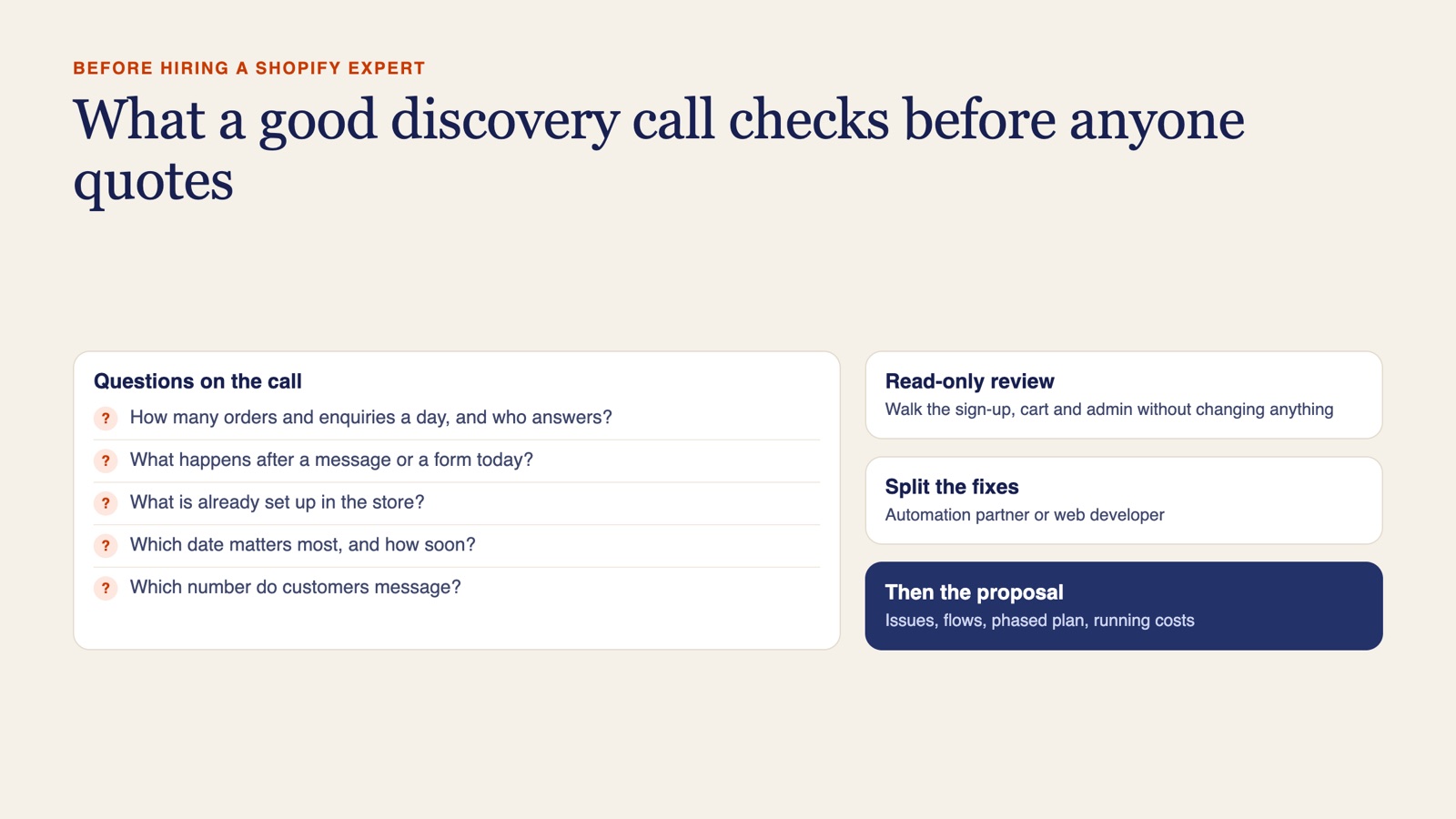
We ask these eight on every store automation call. None is technical, and an owner can answer them all without opening the admin. If someone skips them and goes straight to a tool demo, be wary.
| Question | Why we ask it |
|---|---|
| How many orders and enquiries come in a day, and who answers them? | Volume and headcount set the size of the tooling. A small team on chat needs a shared inbox and clean data long before a CRM priced per contact. |
| What happens today after someone messages on WhatsApp or fills in the form? | This is where the gaps show. If the answer is "nothing structured", confirmation and routing come before any campaign. |
| What is already set up in Shopify? | Welcome and abandoned-checkout emails are often live already. They get refined, not rebuilt, and you should not pay for them twice. |
| Which dates matter most, and how soon is the next one? | The nearest peak sets the order of work. Meta verification and template approval take time, so a Christmas campaign a few weeks out decides week one. |
| What does success look like? | "Double the business" is a fine answer. It tells us where the effort goes and what to measure. |
| Is the WhatsApp number on the website a staff phone or a business line? | Moving a number to the WhatsApp Business API changes how the team works, and how much chat history moves depends on the route. Sometimes a new number is better. |
| Do customers give a different WhatsApp number from their phone number at checkout? | Gift buyers often do. If the store has nowhere to keep it, messages go to the wrong phone. |
| What would this cost each month at today's volume, and if it grows? | Over a year, running costs often outweigh the setup fee. Get both figures in writing. |
Why does the running cost need an answer on the call?
Because the monthly bill has parts that grow at different speeds, and owners usually hear about one. On WhatsApp in the UAE, Meta charges per template message: about AED 0.183 ($0.0499) for a marketing message and AED 0.058 ($0.0157) for a utility message such as an order update. Replies inside the 24-hour window after a customer writes to you are free. So one marketing broadcast to 1,000 UAE numbers costs roughly AED 183. The WhatsApp platform is a separate subscription; BotSpace Pro, which we use, starts at about $15 a month (around AED 55), with Meta's fees passed through at cost.
A full marketing CRM is priced differently. Klaviyo's free tier stops at 250 active profiles, which a store collecting sign-ups properly can pass quickly, and then the price follows the list size. That does not rule a CRM out. It means the cost question needs answering at today's volume and at the one you hope for.
Why walk through a journey map instead of a slide deck?
A deck shows what the supplier sells. A journey map shows what your customer goes through, and it is much harder to nod along to. We share one screen with each step of the customer's path, and for each step note what triggers it, what it should achieve and what to check.
- Sign-up starts from the pop-up or a first WhatsApp message and should end with a welcome and a record that stores consent. Check: is the form connected to the welcome email?
- An enquiry should capture occasion, date, budget and delivery area before a person picks it up. Check: where do those answers end up?
- An order triggers a confirmation with the delivery date and slot. Check: does it ever reach the gift recipient instead of the buyer?
- Delivery updates should fire on a status the team records. Check: does anything in the store record "delivered" at all?
Owners correct the map as we go ("no, that goes to a staff phone"), and those corrections are worth more than any slide. The what-to-check column becomes the to-do list for the review.
What should happen between the call and the quote?
A review of the live store, before any price is written. We ask for a staff or collaborator account with view-only permissions and change nothing. We sign up as a customer and add items to the cart, then open the customer record the sign-up created, go through the installed apps and theme code, and compare what product pages promise with how delivery really runs.
At the gifting store, the review told us more than the call. The sign-up form saved the WhatsApp number into the customer's free-text note, where no automation could use it. Every sign-up was marked as agreeing to email marketing, ticked box or not. A WhatsApp button pointed to a placeholder number. None of this was visible from the owner's side, and anything built on top would have inherited it.
Someone who quotes for automation without looking at your store is pricing a store they have imagined.
Who should fix what: the automation partner or the web developer?
Split the findings by who owns the work, and write the split into the proposal. We kept sign-up, consent, where the WhatsApp number is stored, the chat widget and the flows. Theme code, the cart, delivery promises on product pages and leftover apps went to the web developer.
That stops two suppliers editing the same theme file, and your developer gets a precise list with where to check each item, instead of "the site has issues".
What should a useful proposal contain?
The proposal should read like a plan you could hand to another supplier. Ours has seven parts; expect the same from anyone.
- 01Where things stand: what already works (often more than the owner thinks) and what does not.
- 02Issues found, each with where to check it (the page, the setting or the app), so you can see it for yourself.
- 03The flows, each with its safeguard. Marketing goes out only when consent was given, order messages go to the buyer only, and review requests are skipped while a complaint is open.
- 04A phased plan, nearest peak first, with each phase signed off before the next one starts.
- 05Running costs paid directly to vendors, with no markup, so the accounts and data stay in your name.
- 06Assumptions and exclusions: what the price depends on, and what it leaves out, such as theme fixes your developer owns.
- 07What is needed from you: admin access, a decision on the WhatsApp number, documents for Meta business verification and sign-off on message wording.
The last two are the parts most often missing, and they are where scope arguments tend to start.
What should you have ready before the call?
- A rough count of orders and enquiries a day, and who answers them.
- The next two dates that matter for sales.
- Which WhatsApp number customers use, and whose phone it lives on.
- What is already switched on in Shopify, even if you are not sure it works.
- Your web developer's contact details and what their scope covered.
- One sentence on what success would look like in six months.
Leave the view-only staff account until you have decided you want a review. Nobody needs admin access to ask questions.
Where these figures come from
- Meta's per-message figures are from its published WhatsApp Business Platform rate card for the UAE at the time of writing. BotSpace and Klaviyo figures are their public list pricing at the time of writing.
- The questions, the review steps and the examples are from a recent discovery call and store review we ran for a small UAE gifting store on Shopify. The store is not identified, and nothing described here is live yet: this is proposal stage.