
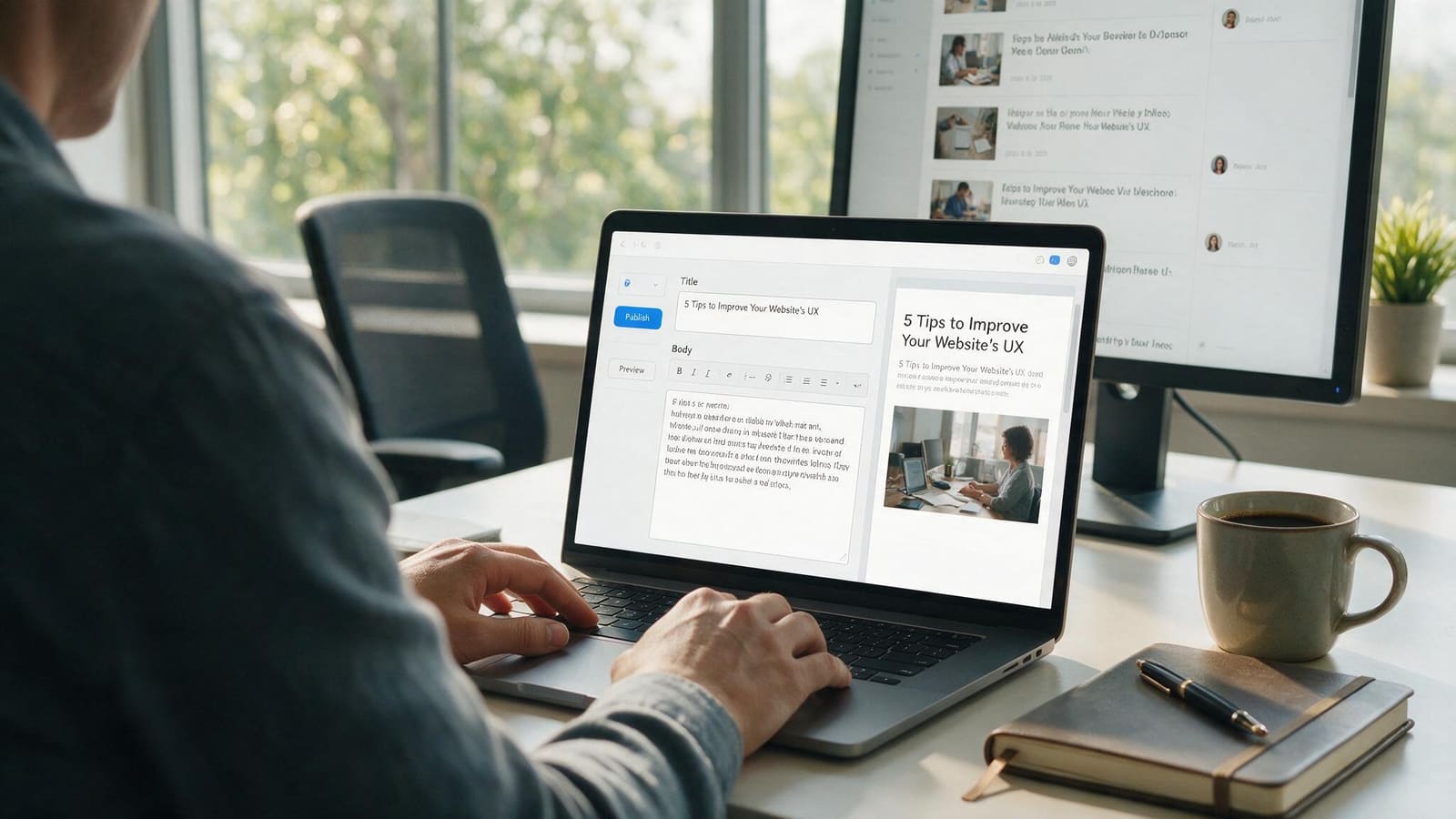
One message in our archive states the problem more clearly than any argument we could make for it. The buyer had received a large number of proposals and was explaining what he actually needed:
Read that again, because two separate requirements are hiding in it. He wants leads. He believes the route to leads is publishing regularly. And he has correctly worked out that if publishing requires him to open a tool he finds impenetrable, it will not happen, however good his intentions are in the week the site launches.
Why the build price hides whether you can edit the website yourself
Editability is invisible in a quote. Two proposals can be within a few hundred dirhams of each other and be completely different propositions once the site is live, because one of them assumed a developer would always be available and the other did not.
| Change | Editable site | Developer-only site |
|---|---|---|
| Fix a typo on a service page | Two minutes, anyone | A ticket, a wait, a fee |
| Add a new team member | Ten minutes | A ticket, a wait, a fee |
| Publish an article | Whenever there is something to say | Whenever there is budget |
| Change a price | Immediately | After the next invoice cycle |
| Add a landing page for a campaign | Same day | Next sprint, if there is one |
None of the right-hand entries is expensive on its own. That is exactly why they accumulate unexamined. Across three years they routinely add up to more than the gap between the cheapest and the most expensive build quote on the table.
The second cost is the one nobody invoices
The direct cost is the developer's time. The larger cost is the work that never happens: the article nobody wrote because it meant raising a ticket, the campaign page that was not worth the friction, the out-of-date pricing that stayed up for four months because changing it was somebody else's job.
This is where the connection to lead generation is real rather than rhetorical. Across our archive of 30,096 project postings, 690 ask for lead generation and 195 of those pair it with SEO or organic ranking. Organic visibility is a function of publishing consistently. A site that makes publishing painful has, in practice, opted out of that channel while still paying for the hosting.
What to ask for
- 01Name the pages and fields you expect to change yourself, before the build starts. Not "the site should be editable", but which page and which part.
- 02Ask to make one of those edits yourself during the demo, on the real site, with nobody helping. Watching it happen is the only proof.
- 03Ask what happens to the layout if your text is twice as long as the placeholder. A page that breaks under real content is not editable in any useful sense.
- 04Ask who can create a whole new page, and whether that needs a developer. This is usually where the answer changes.
- 05Ask for the handover to include a recorded walkthrough of the edits you named in point one.
An easy-to-update website is not really about the platform
The buyer above blamed WordPress. Any CMS can be set up so it is straightforward to edit, or so it is genuinely awful, and the same is true of every platform anyone will quote you. What decides it is whether the person building it treated the editing experience as part of the deliverable or as something to be sorted out afterwards.
Which is why the demo matters more than the platform name. Anyone can tell you a site is easy to update. Ask them to prove it with your own hands on the keyboard, before the invoice, and the answer stops being a matter of opinion.
What an editable website costs with us
Editability is in the scope of every site we build, not an extra. Our Business site (up to 15 pages, custom design, CMS and blog) is AED 7,500 over 4 to 6 weeks and ends with a walkthrough of the edits you named at the start. The smaller Launch site, up to 7 pages, is AED 4,900.
Where these figures come from
- GoDesign brief archive, 30,096 public project postings, read September 2026.
- Client messages quoted are from our own archive, paraphrased only to remove identifying detail.